Simple lifts: Making your fitness journey easy
How one student went from sedentary to strongwoman
Alex Deguzman never grew up playing sports. She ate fast food four to five times a week and had constant inflammation and brain fog. Now, Deguzman is training for marathons and strongman competitions. Her transition into fitness wasn’t made in one day, one workout or even one breakthrough. All that changed was four years ago, during quarantine, when watching her mom doing home workouts, she decided to join her.
Deguzman has always been inspired by her mother, who competed as a bodybuilder and strongwoman. Although Deguzman was originally never interested in working out, she slowly started going to the gym.
The transition from living room workouts to commercial gyms was intimidating, even for someone surrounded by a competitive athlete all her life. Being an amateur in a new environment brought insecurities to the surface for Deguzman.
“It was scary seeing those who were really, really fit,” Deguzman said. “You feel like you’re not enough.”
Despite her fears, Deguzman kept showing up and getting stronger, keeping her own journey as the driving force for her motivation.
“Not caring about how you look, but how you feel. That’s what’s kept me going all these years.”
Now, 50 pounds lighter, Deguzman credits her fitness progress to creating goals and standards that were personal and realistic to her. In her eyes, everybody’s goals, timelines and paths are different. That’s why focusing on her own plan has kept her consistent.
“Comparison is a thief of joy, is what I always tell myself,” Deguzman said.
Fitness and health promotion student Christina Saydé also emphasized the need for your fitness journey to be about yourself.
“The best way to have motivation for working out, (is) it has to be for you,” Saydé said.
“It can’t be ‘Oh, I want to look good for others.’ That isn’t going to last for a very long time.”
Sarah Kingston, a graduate in health and sports management and GoodLife Fitness personal trainer, echoes the value of a personalized plan.
“When you walk in for the first time, your only goal is to learn the space and build consistency, not to crush yourself,” Kingston said.
Considering newbies in the gym can be too eager to make immediate progress, they may take on too much activity too quickly, making them overwhelmed and likely to quit.
“Some people think that trying out all the classes, or adding more than 5 exercises to their routine, or immediately jumping to a heavy weight, will help them see results,” said Kingston. “But this would lead to burnout and eventually plateauing.”
“I tell every beginner that the best workout is the one you can repeat next week.”
Kingston’s top suggestions for newcomers include:
Do a quick warmup before your workout:
“This can be a brisk walk on the treadmill, light cycling or rowing,” Kingston said.
Warmups are not meant to be huge calorie burners. Their focus is to increase blood flow and reduce injury risk.
Keeping it simple allows room to grow:
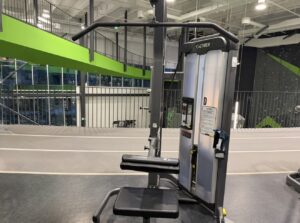
“As a beginner, I strongly recommend using machines first; they help guide your movement and reduce injury risk while you build confidence,” Kingston said.
“Once you’re comfortable, you can explore free weights.”
Building a program is how many people keep track of their progress and routines.
This can range from a hardcore six-day-a-week schedule with planned exercises to a lighter two or three-day-a-week program.
When starting out, Alaistair Kerr, a four-year member at GoodLife Fitness, struggled to build his own program. But through trial and error, he eventually found what worked for him.
“It was hard to find what worked best for me, but I just kept it simple and found a way to work on something that fits me,” Kerr said.
“Now more than four years later, I’m hooked. If I miss the gym some days, I feel sad that I didn’t get to work out that day.”
However, going to the gym regularly doesn’t mean you need to do the exact same workout each time. Saydé advised splitting up workouts between days of the week to target different muscle groups.
“Just start very simply. Like, maybe two to three workouts per week,” Saydé said.
Split training refers to dividing weekly workout sessions or the volume of exercises into separate days to focus on individual elements. Some examples include full-body or push/pull/leg splits.
“You don’t need to work out for three hours to get results. You barely need an hour, like you can get a really good workout in an hour,” Saydé said.
“Just know your limitations.”
A three day split starter example
For Deguzman, who is training for many intense athletic competitions, her program involves lifting weights twice a week, running three times a week and climbing three times weekly.
Deguzman’s program is very advanced and has been cultivated over years of work and consistency.
For some, consistency requires more than just a plan; it demands a clear and meaningful goal.
Breanna Gagliardi, a broadcast television and streaming video student at Algonquin College, says her motivation stems from wanting to see visible muscle growth.
“A goal is just to be able to look at myself in the mirror and see the amount of muscle or amount of definition I want to have as fast as possible,” Gagliardi said.
Deguzman shares a similar mindset, channelling her discipline toward preparing her body for future pursuits.
“Currently, I’m training for a marathon,” Deguzman said. “So that was kind of my motivation to keep going.”
For others, Kerr, having a gym buddy can help with motivation and consistency by making the gym seem less intimidating.
“I was a little taken aback at first. If I weren’t going with a buddy, it definitely would’ve been harder for me to get into it,” Kerr said.
Getting into the gym is the first step, but sticking to the plan is key. Deguzman is currently four years into her fitness journey, and her progress wasn’t earned quickly.
To stay active for years, Deguzman works towards short-term goals like entering bodybuilding competitions. However, what motivates her to stay fit is the long-term health benefits, especially for women.
“Women, after the age, I think it’s age 35, their bone density starts to decrease,” Deguzman said.
“So maintaining muscle is actually good for women long term, because then their bones don’t break down.”
According to Healthline, bone development and maintenance are closely tied to physical activity across a woman’s lifespan.
“Between perimenopause and menopause, bone density often declines rapidly, increasing susceptibility to osteoporosis and bone fractures,” the article stated.
The importance of maintaining that muscle becomes more pronounced later in life.
It adds that “resistance training and balance and weight-bearing exercises are important during this time and may help slow bone density loss.”
Deguzman also pointed to hormonal balance as part of the reason she prioritizes staying fit.
“Keeping your period regular and that sort of thing actually balances your hormones to stay active,” Deguzman said.
Healthline outlines how hormonal fluctuations across the menstrual cycle and into perimenopause affect energy, recovery, and muscle development, reinforcing the role that regular exercise can play in supporting women through these shifts.
But it doesn’t end there.
Regular physical activity delivers multiple benefits for anybody looking to improve their overall health.
“I thought I was mostly going to see and get excited about physical benefits, but in general, I just feel much better. It’s hard to explain, but my mind is just so much better than before,” Kerr said.
The Canadian Psychological Association says regular activity can increase brain health that could potentially improve cognitive ability and limit the risks of cognitive decline, boost self-esteem and reduce the impact of chronic diseases.
“Definitely in terms of mental health, exercise will help you for sure,” Saydé said. “As well as the endorphins that help you sleep better and manage stress better.”
“It also builds character and discipline.”
Discipline is the number one thing Deguzman credits her progress to over the years.
Deguzman has been rebuilding herself day after day, year after year, in the gym. But like everybody, it started with one workout that led into another. Remembering how far she’s come, and what it was like to be an amateur with no fitness knowledge, Deguzman offered the advice she’d give herself if she had to start over.
“Don’t be so hard on yourself, like I said, everyone starts somewhere, and everyone’s goal looks different.”
“Don’t be afraid to ask; someone will be willing to help you.”