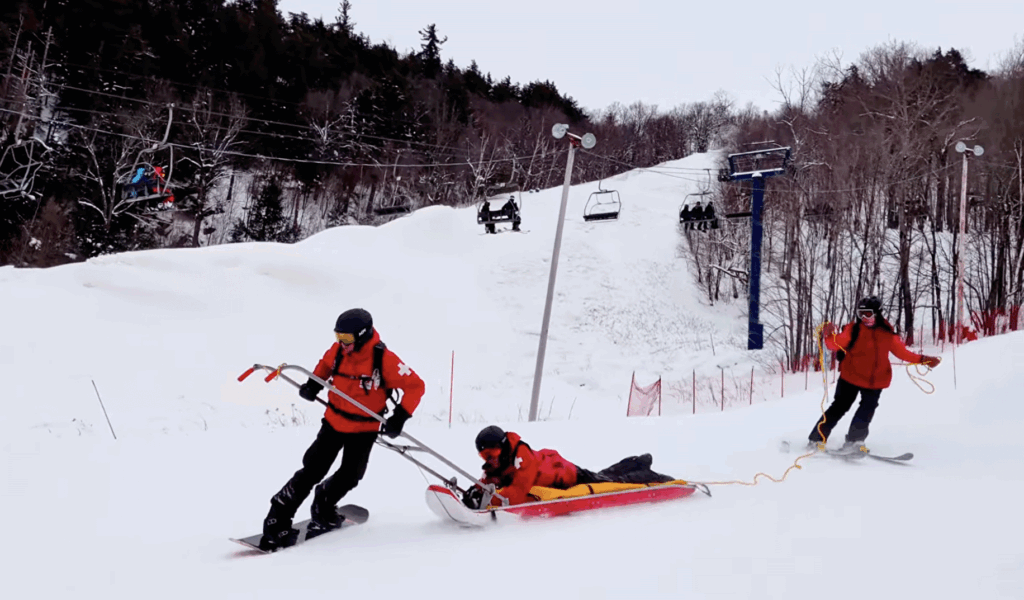
Camp Fortune, one of the Ottawa Valley’s most popular ski resorts, receives thousands of visitors every week.
As with any ski resort, accidents can happen. And that’s where the ski patrol comes in.
The team is part of the Canadian Ski Patrol, a national volunteer organization of over 4,500 members. Fortune is part of the Gatineau Zone within the Quebec Division.
With over 300 members, the Gatineau Zone is assigned to 9 local alpine areas and one nordic area. At Fortune, they’re often first on the scene when someone is in trouble.
“We get called on the radio, or if someone is at customer service, they give us direct communication. We tend to respond instantly, and any injuries are relayed across our radios,” Jacques Desjardins, an assistant patrol leader said.
Once a patient is reached, the team immediately communicates with them and triages their injuries.
“First, we get the circulation and the ABCDs sorted,” Geoff Skeggs, Fortune’s ski patrol leader said. In first aid, ABCDEs is an acronym for Airway, Breathing, Circulation, Disability, and Exposure.
Once the patient is stabilized, Skeggs said they are brought down the hill and into the clinic.
“What we do here is first aid,” Skeggs said. “It’s the initial stabilization and treatment of an injury, to ready the patient for a higher level of care.”
Skeggs thinks of the patrol as the hill’s paramedics. Apart from immediate witnesses, patrollers are first on the scene, where they perform their own scene assessments with meticulous attention. Not only do they analyze the patient, but they also work to ensure hazards are addressed to protect both the patroller and the patient. Often, that means directing other skiers away from the scene.
If patients suffer serious injuries or are unable to ski down themselves, assistance will be requested, along with equipment. In extreme circumstances, an ambulance will be dispatched to transport them to nearby hospitals in Gatineau or Ottawa.
Extraction equipment can be found in cabins at the top of the hills, where it’s kept accessible and warm for use in extractions and emergencies.
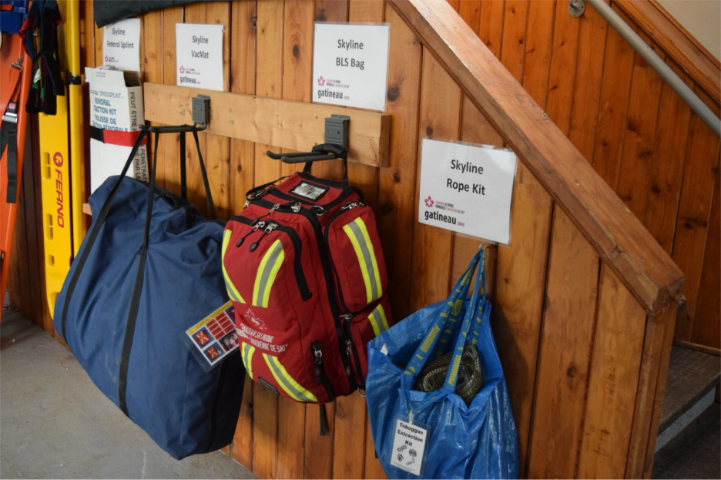
Items include rope extraction kits for instances where patrollers need to lower themselves down a hill to reach patients; a basic life support bag with oxygen, defibrillators, and other specialized supplies; or vacuum mattresses (VacMats) for securing patients on a toboggan.
Vacmats, basic life support bags and skyline rope kits hung up at one of Fortune’s equipment cabins. (Photo: Lara Simard)
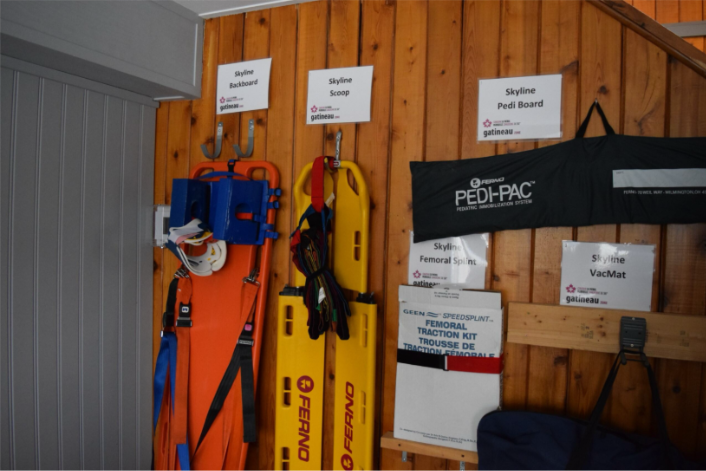
Other equipment includes boards of different sizes or scoop stretchers used for mobilizing patients for a safe extraction.
Items like femoral splints may also be used to reduce pain and minimize further damage to the femur, the largest bone in the body, and a painful one to injure.
Emergency and extraction equipment is all provided by the Canadian Ski Patrol (Photo: Lara Simard)
From leg to upper body injuries, to more serious trauma like spinal worries, injuries on the hill can often vary in location and severity.
“That’s why it’s important to have a good complement of equipment,” Skeggs said.
“It’s also why patrollers always analyze a crash scene upon arrival, discuss approaches, and evaluate each situation, ensuring that the extraction can be performed safely and efficiently.”
When ready, patrollers prepare a VacMat, secure any injured body parts and carefully load the patient onto the toboggan, where they can be transported down the hill for further treatment.
Accidents happen. And that’s what the patrol is for, but they warn that many can often be avoided. Skeggs’ advice? Follow the mountain’s code of conduct, keep an eye out for other skiers and respect those around you.
“Outside of that, a properly worn and fitted helmet is probably the most important thing,” Skeggs said.
Got questions?
Feel free to reach out.