The Local Scoresheet focuses on local and amatuer athletes who are striving for greatness!
The Price of the Puck
The Price of the Puck
How Hockey’s Rising Costs Are Changing Who Gets to Play
On freezing winter days across Canada, the sound of skates carving into fresh ice, coaches calling out drills and parents cheering from cold metal bleachers echo throughout local arenas. These frigid, loud, and Canadian spaces are more than recreational facilities. They’re gathering places and a second home to many people across all ages and cultures.
Hockey occupies a unique place in Canadian life. It’s a common language across provinces, and a part of the country’s cultural identity.
The sport’s origins in Canada were far simpler. In the early 20th century, young players skated on frozen ponds or makeshift community rinks with whatever equipment they could find. Organized leagues were less specialized and far more affordable. For many, hockey was one of the most naturally accessible activities. If you could skate and someone could lend you a stick, you could play.
That accessibility helped cement hockey as a defining part of Canadian life. Even today, emotional attachment remains strong. For many, the rink is where social and athletic skills are built and lifelong memories are made. Without it, our winters just wouldn’t be the same.
115,000+ women and girls registered (Hockey Canada)
7,000+ indoor rinks across Canada (Statista)
But the sport that once felt universally accessible has shifted. And as the game evolved, so did its financial reality.
The Rise of the Hockey Business
What began as a simple community activity slowly turned into a broader business. New rinks opened with extra programs and the stores around them adjusted to match the demand by filling their shelves with new gear. One fed into the other. As the game expanded in one area, the rest of the hockey world grew right along with it.
The equipment industry became one of the earliest drivers of rising costs. Manufacturers began developing lighter, stronger and more specialized gear. Composite sticks replaced wooden ones, skates were engineered for precision and speed, and protective equipment became increasingly technical. While these changes improved performance for elite athletes, they also elevated the cost for everyone else.
For those working within the sport, the financial shift has been especially noticeable. Joe Baker, owner of B-Sharp, an Ottawa-based skate sharpening and hockey service shop, said his 25 years of sharpening skates have given him a firsthand view of how equipment costs have changed behind the scenes.
“Equipment for us is the biggest cost raise, especially things like sharpening wheels, they have almost doubled in the last three years,” Baker said.
That increase reflects how rising costs are not limited to players and families but are also felt throughout every level of the hockey industry, including the businesses responsible for maintaining equipment behind the scenes.
Those pressures, Baker said, are tied to broader forces shaping how hockey equipment is produced and priced.
“There’s a monopolized version of what’s out there for equipment,” Baker said. “You’ve got CCM and Bauer, along with Warrior and True, producing high-quality but high-priced products. Those companies largely set the price, which is one of the biggest reasons costs are so high.”
Marketing only added fuel to the sport’s transformation. As new equipment was released each season, parents increasingly felt pressure to keep up, equating newer gear with better performance. Top-tier sticks costing hundreds of dollars became the standard despite their reputation for breaking easily.
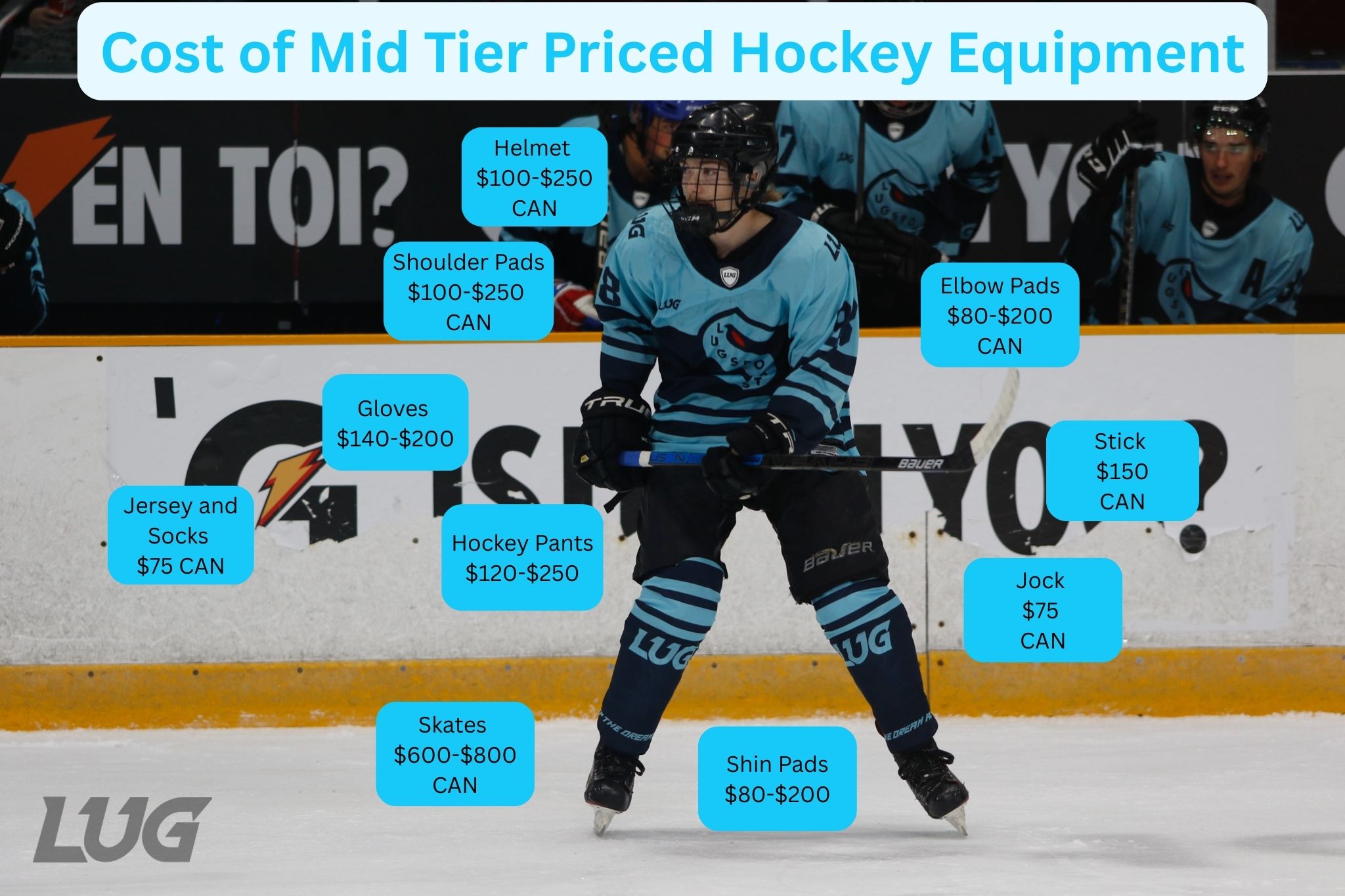
To show the financial truth behind today’s equipment, the graphic below highlights the approximate price of each piece of gear worn by a typical player.
Jaiden Martin wears a full set of standard equipment. The blue labels show the approximate current retail cost of each item, based on typical market pricing. Photo Credit: LUG SPORTS
At the same time, the structure of youth hockey changed. Specialized skill training became the standard for players aiming to keep pace with their peers. These weren’t mandatory but once a few families invested in extra training, it became normalized within entire teams.
Hockey associations and governing bodies have also adapted to meet demand by introducing more divisions, and more frequent competitions. These events often require travel, pulling parents and students away from their responsibilities. When you add tournament fees and hotel costs, the financial and time burden can become significant.
By the time many families understood how much the landscape had evolved, the financial weight had already cemented itself into the sport. Hockey still had the same cold rinks and early mornings, but the atmosphere was no longer as simple or as effortless as it once felt. What used to be a straightforward escape now came with decisions and costs that were hard to ignore. The game had not lost its heart but keeping up with everything else around it made it harder to hold onto the peace of mind it used to bring.
Where Hockey Is Today
Hockey today still has a large widespread appeal but for many families, it comes with a growing set of challenges. The sport that once felt open to nearly everyone now carries a financial weight that shapes decisions on and off the ice.
Connor Dickey, who grew up playing both minor and junior hockey, said hockey has always been central to his family life.
“It is something that we enjoy as a family and something we are very passionate about,” Connor said. “Having family come to watch and spend time together is awesome. Cheering on the Sens and youth or junior hockey are some of the best memories we have had are thanks to being around the rink.”
Connor Dickey celebrates his first career CCHL goal. Photo Credit: Nepean Raiders.
Mark Dickey, Connor’s father, added that while the experience has been rewarding, it has become more costly over the years.
“Typically, the higher the level, the more cost comes with it,” Mark said.
Equipment is another major factor. Connor said that in the early years, he and his brother often shared gear to manage costs.
“Instead of buying gear for both of us, we limited it to buying for one most of the time.” Connor said.
Connor also reflected on the culture around extra training and development.
“Sometimes doing too much extra development has negative effects and many people do feel pressured to go,” Connor said. “Everyone’s different. There is a balance, but making sure you stay hungry without being burnt out is key.
The Dickeys have also seen families step away from hockey when costs grow too high. Connor said that when the switch from AA to AAA occurred, some families chose not to allow their children to try out because the financial burden was too great.
For the families who made the switch, strategies were made to account for the cost.
“There are initiatives that can help drive down prices,” Mark said. “For example, in junior hockey we get middle-of-the-pack sticks for $125, which is a good price these days. But there are also a lot of money-grab things associations have that drive up costs.”
Mark emphasized that keeping hockey affordable requires practical choices.
“Kids do not need new hockey bags or tracksuits every year, just scrap the unnecessary spending and try to be mindful or efficient on where the money is going,” Mark said.
Even with careful planning and hand-me-downs, balancing the joys of hockey with its rising costs is an ongoing challenge.
Hockey continues to be a source of memories for Canadians. But as the Dickeys experience shows, the rising costs highlight a growing divide. For hockey to stay a game for everyone, it must remain affordable and accessible.